OUT NOW: JULY/AUGUST ’26 ISSUE #181
News and insights from the movers and storers industry


10th September 2026
Editorial Team
The latest CSTA Container Self-Storage Census charts continued expansion, high occupancy and a market increasingly shaped by longer stays, business demand and technology-led operations.
The UK container self-storage market continues to build scale and maturity.
The CSTA Container Self-Storage Census 2026, based on industry research as at 1 January 2026, records 684 operators running 1,218 sites and providing 112,150 containers.
Together, those facilities represent more than 16.7 million sq ft of capacity – a clear indication that container storage is no longer a small, opportunistic corner of the wider self-storage market, but an established and increasingly professional service sector.
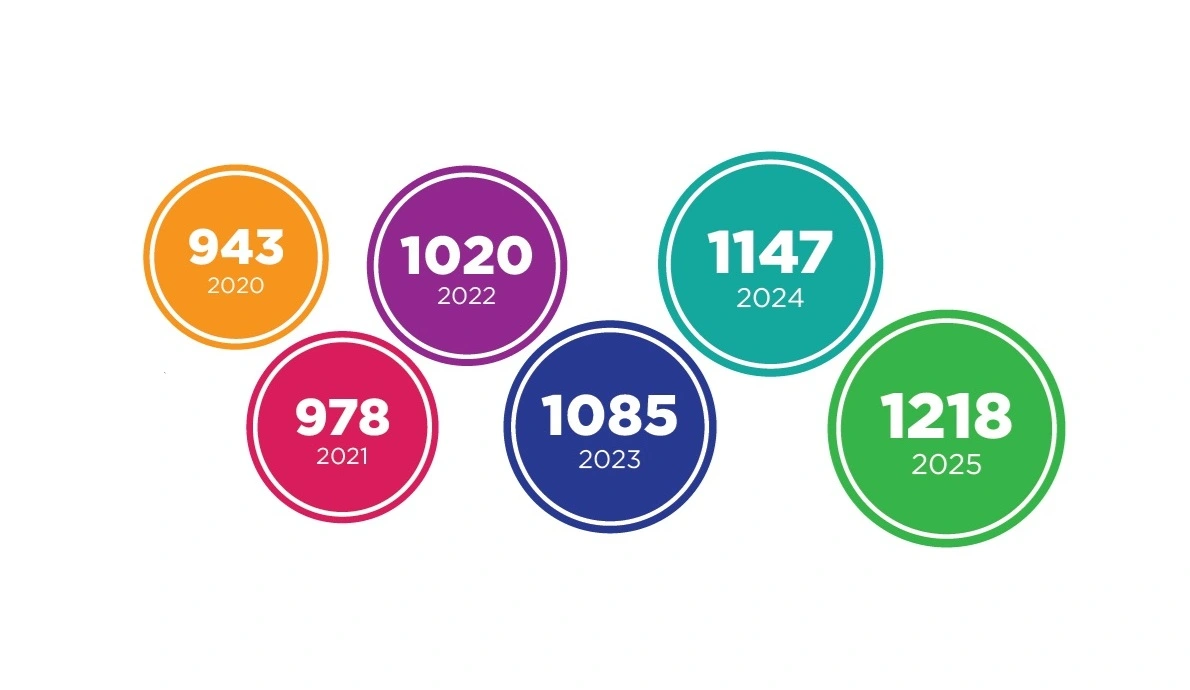
The figures also underline the pace of recent development. More than 70 new sites opened during 2025, taking the number of container self-storage locations from 1,147 at the end of 2024 to 1,218. Since 2022, the market has added at least 60 sites a year. Expansion is being driven by established operators adding capacity, as well as new entrants attracted by demand from householders, small businesses and tradespeople.
Although prime land, planning constraints and local competition can slow progress in some places, the overall direction remains firmly upward.
The number of UK container self-storage sites reached 1,218 at the end of 2025, following more than 70 new openings during the year.
Container numbers rose by 11% in 2025, from 100,980 to 112,150. The growth was greater than the previous year’s 9.49% increase, with additional units deployed both at existing sites and at new developments. The Census notes that this trend points to a continuing annual requirement for thousands of containers, supported by established procurement routes through container traders.
Most facilities remain centred on 20ft ISO containers, though operators are adapting their offer through 10ft, 40ft and 8ft units, as well as subdivisions for customers requiring smaller spaces. Capacity has now reached 16,752,967 sq ft, compared with 15,084,392 sq ft a year earlier. That rise reflects confidence in demand, while also giving operators a platform to diversify unit mix and services.
Occupancy remains one of the sector’s strongest indicators. Almost two-thirds of respondents, 63%, reported occupancy between 90% and 99% in 2025, up from 57% in both 2023 and 2024. This is positive evidence of healthy demand and efficient operations.
However, the Census makes an important practical point: total sell-out is not necessarily the ideal. A small number of empty containers helps prospective customers view a unit and avoids the perception that a site is always full. For operators consistently above 90%, the data provides a useful prompt to review both capacity and pricing.
Pricing is also moving gradually upwards. The most common monthly rental band for a 20ft-equivalent unit is now £150-£200, accounting for 33% of responses. London and the Home Counties continue to command the strongest rates, particularly where monthly rents exceed £200. Location, nearby competition, security and site improvements all play a part in the rent achieved.
The customer profile points to a market providing more than short-term stopgap storage. In 2025, 55.5% of customers stayed for at least 12 months, while only 11% remained for under six months. The shift suggests a stronger role for container self-storage among SMEs, local tradespeople and customers seeking a long-term extension to their home or business premises. Business customers now represent 46% of the base, compared with 44% in 2024.
Technology is helping operators serve this broader market efficiently. Unmanned or sometimes manned sites account for 73% of operations, underlining the appeal of automation and low-overhead management. Key or combination locks still dominate, but digital locks have started to appear, representing 4% of reported lock types. Meanwhile, 54% of operators manage sites larger than one acre, while smaller, remotely managed facilities continue to offer a practical entry point for entrepreneurs.
Overall, the 2026 Census portrays a market that is expanding in volume while becoming more structured in its approach.
The next phase will depend on operators balancing growth with service quality, security, technology and local pricing discipline – while continuing to make flexible storage accessible to both domestic and commercial customers.






All the best bits, delivered once a month straight to your inbox
News and insights from the movers and storers industry