OUT NOW: SEPT/OCT ’26 ISSUE #182
News and insights from the movers and storers industry


30th October 2026
Editorial Team
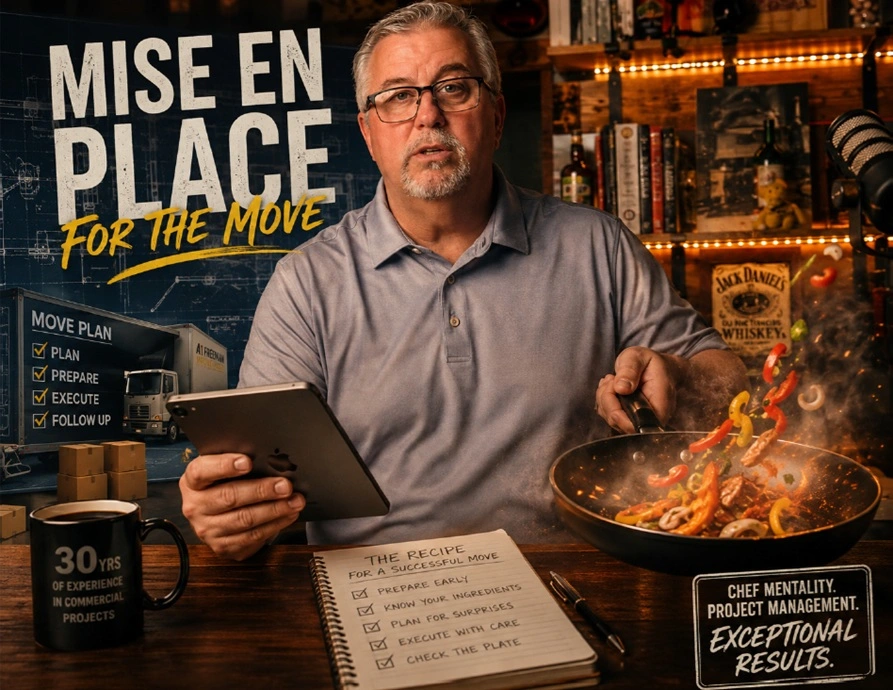
What 30 years of feeding people has taught Rob Clark about relocating them.
Rob Clark (pictured above), an IOMI Certified Office Mover, has spent three decades in commercial moving, developing scopes of work, project phases, and contingency plans for relocations, decommissions, and workplace transitions.
He currently works with A1 Freeman Moving Group, where his approach centres on solving problems before they happen – cost-effective, well-sequenced plans that minimise risk, disruption, and lost time for a company’s staff.
When he’s not on a job site, Rob hosts Bottles & Bites Without Borders, a podcast and YouTube channel exploring food, wine, and whiskey through stories, tastings, and conversations with fellow enthusiasts and top-tier industry experts.
He’s WSET-certified in wine, a self-described bourbon collector, and a home chef who’s just as at home behind a V60 pour-over as he is at a tasting table. Whether he’s walking a building manager through a move plan or pouring a glass for a guest, Rob’s approach is the same: know your craft, plan for what could go wrong, and make the experience genuinely enjoyable for the people you’re doing it for.
Rob tells The Movers & Storers Magazine about the similarities of his two working lives.
Every good kitchen runs on a simple discipline: mise en place. French for “everything in its place”, it means every ingredient is measured, every pan is staged, every backup is within arm’s reach before the first order ever hits the pass. A chef doesn’t start service hoping things go well. They start service having already solved the problems that haven’t happened yet.
I spend my life in two worlds that, on paper, don’t have much in common: commercial moving and hospitality. One is trucks, timelines, and freight elevators. The other is bottles, tasting menus, and dinner parties. But the longer I do both, the more I’ve realised they run on the exact same discipline. The best move I ever managed and the best dinner I ever cooked succeeded for the same reason – nothing that happened was actually a surprise.
In a kitchen, prep isn’t the boring part before the real work starts. Prep is the work. The dish that looks effortless on the plate is effortless because of two hours nobody saw.
A commercial move is the same. The walkthrough – measuring doorways, checking elevator capacity, flagging the marble lobby that can’t take a scuff – isn’t the preamble to the move. It’s the move. By the time the truck backs up to the loading dock, the plan should already have absorbed every awkward stairwell and every building manager’s pet concern. Clients don’t remember a smooth move day. They remember whether their receptionist’s desk showed up broken, or whether the hallway got scratched. The walkthrough is where that outcome actually gets decided.
A good chef doesn’t build a menu around ingredients they hope show up. They know their suppliers, their backups, and what’s actually in season before they promise a dish.
The equivalent on a move is knowing, in writing, what you’re actually dealing with before you price the job: headcount, square footage, IT dependencies, freight elevator reservations, building insurance requirements, move-in/move-out windows at both ends.
Guessing at any of these is how a fixed-price job turns into a budget conversation nobody wants to have on move day. Cost-effective isn’t the same as cheap – it’s knowing your real inputs early enough that the number you quote is the number you deliver.
In a restaurant, the pass – that’s
to say, where the chef checks
every plate before it goes to the
table – is where accountability
lives. Nothing leaves the kitchen
that hasn’t been looked at by
someone who’s responsible for it.
Ask any chef what happens when the walk-in cooler goes down two hours before a 200-cover dinner. They don’t panic — they’ve already got a backup vendor, a modified menu, and a story for the guests that makes it feel intentional. That’s not luck. That’s contingency planning built into the culture of the kitchen.
Commercial moves need the same instinct. What happens if the freight elevator is down the morning of? If a permit falls through? If the new space isn’t actually ready? The teams that handle this well aren’t the ones who never hit a snag — every project hits one eventually. They’re the ones who already know what they’ll do about it, so the client never feels the wobble. That’s the real deliverable in this business: not the absence of problems, but the invisibility of them.
In a restaurant, the pass – that’s to say, where the chef checks every plate before it goes to the table – is where accountability lives. Nothing leaves the kitchen that hasn’t been looked at by someone who’s responsible for it.
I try to run projects the same way. A final walkthrough with the client isn’t a formality – it’s the pass. It’s the moment you catch the thing that would have become a complaint, a change order, or a damaged relationship if it had gone out the door unchecked.
It’s also, frankly, where the relationship gets built. People remember who checked in on them, who asked how it actually went, who cared whether the outcome matched the promise.
What connects a well-run kitchen and a well-run move isn’t the industry. It’s the mindset: plan for what could go wrong so thoroughly that when it does, nobody but you notices. Do the unglamorous prep. Know your real inputs before you price anything. Build the backup plan before you need it. And check the plate before it goes out.
That’s mise en place. It works with a knife in your hand, and it works with an IPad.
Click here to learn more about Rob and listen to his podcasts.
Click here to connect to Rob on Linkedin.





All the best bits, delivered once a month straight to your inbox

27th March 2026
Editorial Team
16th September 2026
Editorial Team
4th September 2026
Editorial Team

News and insights from the movers and storers industry