OUT NOW: NOV/DEC ’26 ISSUE #183
News and insights from the movers and storers industry


23rd November 2026
Editorial Team

Despite falling buyer demand, Britain’s housing market remains resilient. Daniella Porter of TwentyCi examines emerging trends and opportunities for removals and storage businesses in 2026.
Based on current market performance, we continue to forecast 1.16m transactions in 2026: 4.5% fewer than in 2025 but 5% more than in 2024.
With interest rates above 5%, the crisis in the Middle East showing no signs of easing, energy bills soaring, and the cost-of-living biting hard, you’d be forgiven for thinking this perfect storm would have left the housing market on its knees. And yet, here we are in Q4, reflecting on a housing market that, though underwhelming, is not disastrous by any stretch.
Despite, or perhaps because of, the economic climate, the UK hasn’t lost its desire to move. The supply of new properties listed for sale is the highest it’s been in a decade: music to the ears of a would-be buyer who is seemingly spoilt for choice.
Supply is up 1.9% year-to-date 2026 versus the same period last year, and this is across all price bands below £1 million. The more affordable end of the market is where growth is most pronounced, with stock up 3.5% for £0 to £200k properties and 2.4% for those priced between £200k and £350k.
More stock is coming to the market in the south, with the largest increase observed in the South East at 3.8% growth year on year. Of the 13 UK regions, ten saw supply rise. The three regions that saw stock decline include Northern Ireland, with supply down 4.4% year-on-year, and Wales, where stock fell by 2.6%.
Looking at the third quarter in isolation, new instructions have nudged slightly higher, with a 0.4% rise when comparing Q3 2026 with Q3 2025.
The shelves are stocked, so where are the shoppers? Naturally, buyers are showing caution. Sales agreed volumes (measured as demand) are down 5.7% year-to-date 2026 versus the same period in 2025. Affordability pressures are weighing on activity. Demand has reduced across the entire country but felt most heavily in Inner London, where it contracted 10.1% year on year. This was followed closely by Northern Ireland at 9.8%. All price bands have seen demand decline, but the lowest-priced properties below £200k experienced the biggest fall at 6.9% year on year.
Demand has fallen for five consecutive months, with fewer offers being put on the table since May. Sales agreed volumes fell 8% year-on-year in both May and June. Going into Q3, the decline eased slightly in July to 5%, before widening again to 6% in August and 7% in September, resulting in an overall 6% quarterly year-on-year comparison.
This drop means we’re now looking at a winter of discontent as this feeds through into lower transaction volumes in Q4 2026.
HMRC transaction volumes were down by only 3.1% in 2026 compared with the same period in 2025, with 757,200 transactions recorded so far this year. Not a bad result given that Q1 2025 benefited from inflated transaction levels thanks to Stamp Duty relief. When we compare year-to-date 2026 with the same time period in 2023 and 2024, transactions were 14.2% and 9.5% higher, respectively.
Before we get too excited: cracks are starting to show. August recorded an unseasonably low transaction volume, which was 8.4% lower year-on-year. The month is traditionally regarded as one of the busiest months for moving, with families keen to get settled before the new school year, longer daylight hours making moving easier and many buyers and sellers planning their move around the summer holidays. This could be the first sign of the weaker demand we have observed since May beginning to filter through to transaction levels.
Our latest research looks at whether 55- to 64-year-olds are downsizing based on what they’re selling and what they’re buying.
The analysis compares two separate groups: people aged 55 to 64 who completed a sale in 2026 to date, and people aged 55 to 64 who completed a purchase in 2025. The result is a profile of what the 55 to 64 age group sells, set against a profile of what the same age group buys.
First and foremost, we can see the share of older people active in the market increasing. Over-55s in England accounted for 44.1% of newly listed properties in Q3 2026, up 4% on the previous year, 10% on 2024 and 18% higher than Q3 2019. Our view is that downsizing is a primary reason.
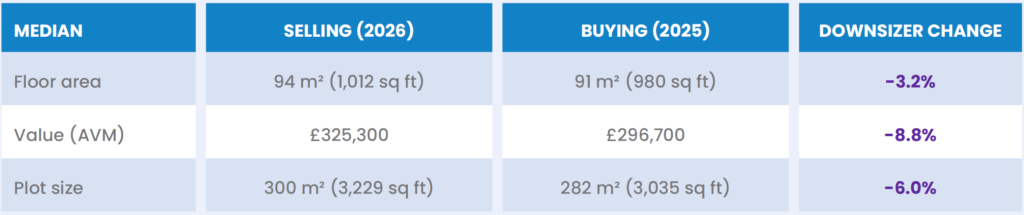
This age group sells larger homes on larger plots, worth more. The median home sold by this group in 2026 was valued at £325,300. The median home bought by the same age group in 2025 was valued at £296,700, which is 8.8% lower.
Delving deeper into property type and bedroom count, we found that this age group are more likely to move out of a detached property and significantly more likely to buy bungalows.
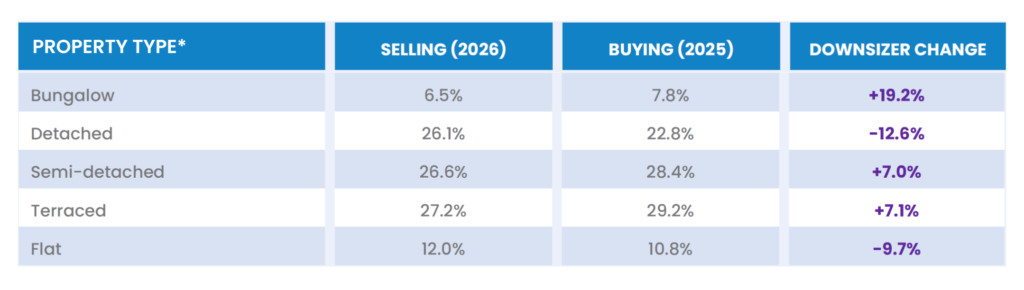
* Other property types make up the remainder.
The cohort is also more likely to be moving out of 4–5-bedroom homes and into 2- 3-bedroom properties.
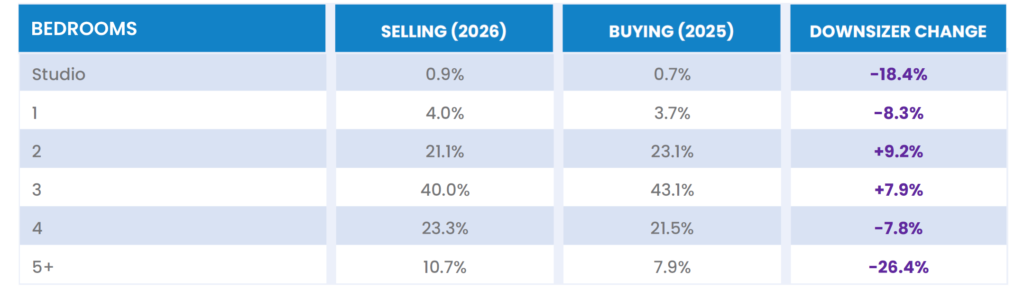
Moving from a four- or five-bedroom home into a two- or three-bedroom one means more rooms to clear than there are to fill. For removers, that points to larger jobs. For storage operators, it points to households with furniture their new home has no more room for.
The SSA’s 2026 report found 55- to 64-year-olds were the largest group of storage customers, at 31%. The gap between what this age group sells for and what it buys for also suggests many are releasing equity when they move.
The supply of properties to rent has risen by 12.1% in the last year. Ten of the 13 UK regions saw supply growth of more than 10%. Let agreed volumes have increased by 3.1% year-to-date 2026 versus 2025. Demand for lets has risen in eleven of the 13 regions, with the strongest demand in Wales, up 12.1% on 2025. Inner London and Northern Ireland were the only regions with falling demand at -1.4% and -7.3%, respectively.
Buyer caution, affordability pressures and an uncertain economic backdrop continue to keep the market subdued, and with demand contracting and mortgage rates creeping to 6%, it may seem the housing market is holding its breath.
However, the announcement of the Your First Home scheme should mean a rise in moves from this new homeowner audience. Meanwhile, the rollout of the Home Buying and Selling Roadmap offers hope of finally tackling the painfully long transaction timescales. Let’s see how quarter four plays out.






All the best bits, delivered once a month straight to your inbox

News and insights from the movers and storers industry