OUT NOW: SEPT/OCT ’26 ISSUE #182
News and insights from the movers and storers industry


6th November 2026
Editorial Team
A practical operator note on turning comparable inventory data into a fleet review, without confusing “volume” with “payload” – or a final vehicle decision.
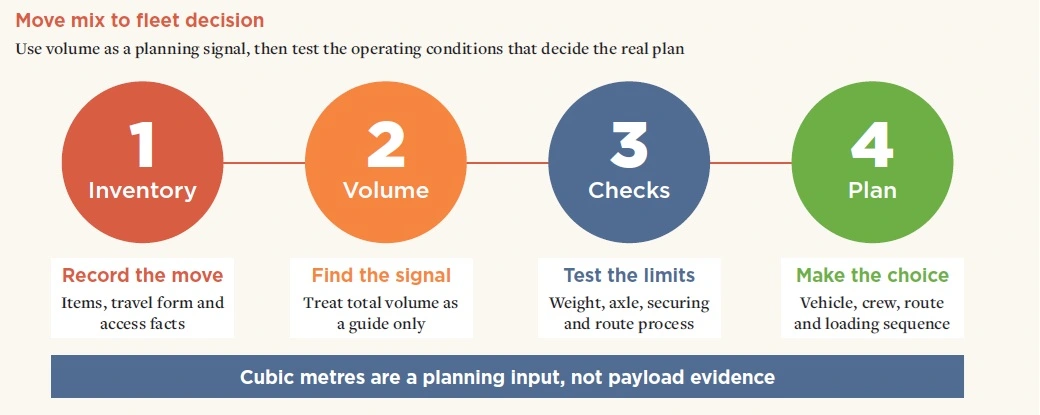
When a removal business considers changing its fleet, the conversation can begin with vehicle class. The more useful first question is what the business actually carries, where it carries it – and under what access conditions.
That distinction matters because a household move is not a standard unit of work. Two jobs that are both described as a “two bedroom move” can place very different demands on capacity, crew time and route planning. One may involve a compact flat with mostly boxed contents. The other may include assembled wardrobes, a corner sofa, appliances, difficult access and a fixed service lift slot. A broad property label can be useful for enquiries, but it is a weak basis for deciding whether the current fleet suits the work.
A practical first step is to turn the move mix into a comparable inventory record. The record does not need to be elaborate. It needs to show the furniture categories that drive space, the travel form of bulky items, the volume of boxes, the access constraints and whether a return trip would be workable.
| Planning signal | What to record | Why it matters |
| Bulky furniture | Sofas, wardrobes, beds, tables and appliances. | These items often drive usable space and loading sequence. |
| Travel form | Whether an item travels assembled or dismantled. | The same item can occupy very different space in each form. |
| Access | Floors, lifts, loading position, carry distance and time windows. | Access may change the practical value of one vehicle or a return trip. |
| Weight and loading | Dense items, vehicle plate, axle position and securing needs. | Volume is not evidence of legal payload or a safe load plan. |
Table: A compact record gives the fleet review a repeatable operational basis.
This is where a transparent volume method can help. Men With Van has published a 2026 planning dataset with 124 inventory items and 145 item or travel form rows. The model adds the selected quantities and compares the result with a 19 cubic metre guide allowance for each full-size Luton van. It deliberately stops short of pricing, payload, crew size or a final fleet recommendation.
The value is not the particular number 19. It is the discipline of making assumptions inspectable. A removal operator can review which items commonly move the result from comfortably within one vehicle to close to its guide capacity, and which choices create a likely second vehicle. An assembled double wardrobe in the published example is listed at 2.5 cubic metres, while its dismantled form is listed at 1.2 cubic metres. That difference is a prompt for an operational question, not a promise that either arrangement will fit.
The same point applies to starter lists. A one bedroom flat, a two bedroom home or a small office is not a fixed physical load. Any planning tool should allow the operator to replace generic entries with the actual inventory, identify unusual pieces and mark the travel form that is really agreed. Keeping the assumptions visible makes it easier to compare jobs over time without pretending that every move of a given size is the same.
A volume total cannot establish payload because it does not include item weights, vehicle kerb weight or axle position.
This separation is important for compliance as well as planning. GOV.UK says that design gross weight is shown on the vehicle identification plate and includes the vehicle, driver, passengers, fuel and load. It also says that overloading can affect safety and that individual axle limits matter. GOV.UK and HSE guidance both make clear that goods must be stable and secured. A cubic metre figure does not reveal any of those things.
For that reason, a good fleet decision has two stages. First, use move data to identify a recurring capacity pattern. Perhaps larger assembled furniture regularly pushes a route into a close capacity range. Perhaps a cluster of high-rise jobs makes one trip impractical because the lift slot is fixed. Perhaps dense collections require a different vehicle check even when their volume looks modest.
Second, test the proposed change against the operational constraints that volume cannot answer. Check the actual vehicles, legal weight position, axle loading, securing equipment, access process, route timing and crew workflow. The answer may be a different vehicle, an extra run, a revised loading sequence, a separate specialist service or a better enquiry record. The important point is that the choice follows evidence from the jobs the business performs.
Transparent methods help because they turn a vague fleet conversation into a repeatable review. They do not replace professional judgement. They give that judgement a clearer record to work from.
This article has been contributed by Men With Van . The contribution is supplied as an editorial data note. The published methodology is an open planning resource and does not provide a payload calculation, a price, or a guarantee about a particular move
Source material
1. Men With Van, Van size calculator methodology, 2026 edition.
2. GOV.UK and DVSA, Driving a van.
3. GOV.UK and DVSA, Securing loads on HGVs and goods vehicles.
4. Health and Safety Executive, Load security.






All the best bits, delivered once a month straight to your inbox

News and insights from the movers and storers industry