OUT NOW: SEPT/OCT ’26 ISSUE #182
News and insights from the movers and storers industry


14th September 2026
Editorial Team

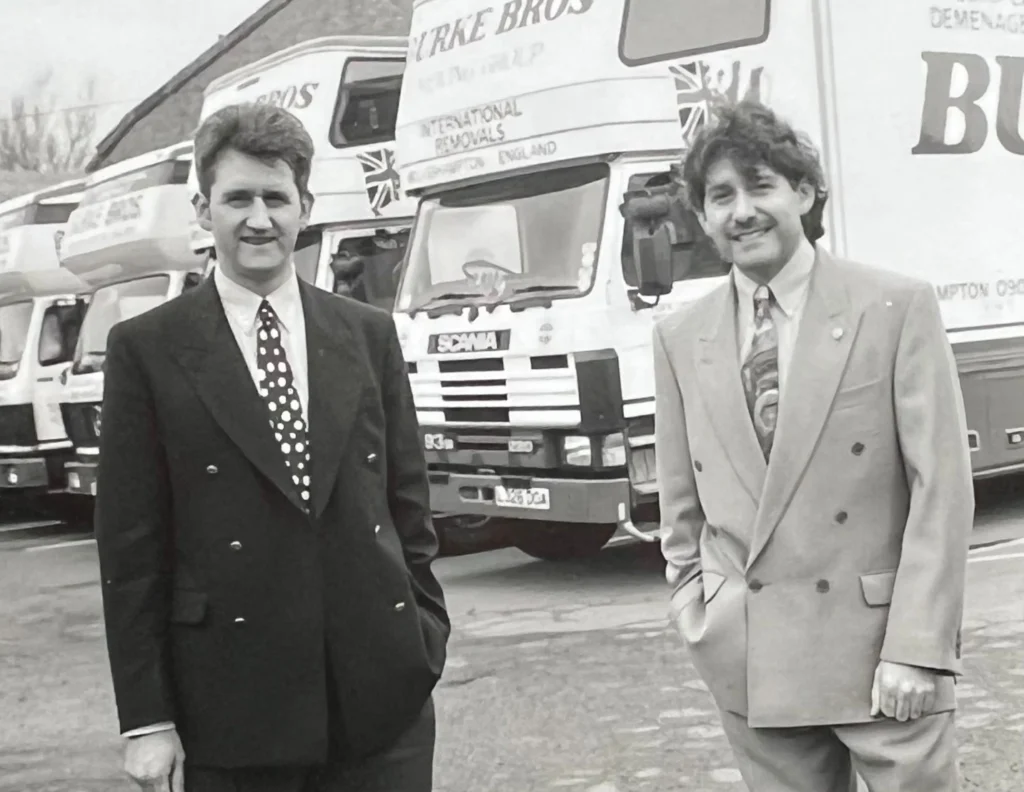
The founders of Burke Bros reveal the lessons they’ve learned over four decades in removals .
When Chris and Gary Burke started Burke Bros Moving Group in 1982, the removals industry was a very different place.
There was no internet, no email, no social media, no smartphones and certainly no artificial intelligence. Customers found removal companies through recommendations, directories, advertising and quite often, a local company they had known about for years.
The brothers started with less than £1,000 and a Luton van. Within three years, the business had grown to five vans, with offices and warehousing – and the company soon began looking beyond the domestic market. Membership of the British Association of Removers came in 1985, with FIDI and international industry affiliations coming later. Its first moves into Europe were followed by its first international consignment to Hong Kong in 1987.
Now, more than four decades later, the business operates across domestic, commercial, corporate, international moving and storage, with a network and infrastructure that would have been difficult to imagine in those early days.
So what does 44 years in the industry teach you?
Perhaps the biggest lesson is that while almost everything around a removal can change, the fundamentals of moving someone’s possessions from one place to another really haven’t changed at all.
There is a temptation to think that the removals industry has transformed completely over the last four decades. In many respects it has.
The technology available to businesses today would have seemed extraordinary in 1982. Customer expectations have changed. Regulation and compliance have increased considerably. International moving has become more sophisticated, while logistics, communication, tracking and information management have all become integral parts of running a modern removal business.
But underneath all of that, the physical process remains remarkably familiar.
You still arrive at a customer’s home, carefully pack and protect their possessions, load them, transport them safely and unload them at their new destination.
As Chris Burke observes, when reflecting on the company’s first 40 years, the actual removal process has changed very little. What has changed around it is the level of compliance, technology and customer expectation.
That distinction is important.
The successful removal businesses of the future will need to embrace change, but they should not confuse “technology” with “service”.
A customer moving house is still entrusting a company with virtually everything they own. They want to know that their furniture will be protected, their possessions will arrive safely and that, when something unexpected happens, there is a knowledgeable person at the end of the phone who will take responsibility.
Technology can make that experience better. It cannot replace the responsibility.
One of the biggest changes in Burke Bros’ own history was the move from being a domestic removal company into international moving, storage and wider relocation services.
The company’s first international moves to Europe came relatively early, followed by the Hong Kong shipment in 1987. Over time, the business developed international relationships and accreditations and expanded its capabilities.
That evolution reflects a broader change in the industry. Removals are no longer simply about a truck travelling from one house to another. Customers can be moving between countries, employees can be relocating as part of corporate assignments, belongings may need to be stored for weeks or months, and international moves can involve multiple transport modes, customs requirements and overseas partners.
The industry has become more professional and more interconnected. It has also become more competitive. For established businesses, longevity cannot be taken for granted. A strong reputation built over decades is valuable, but it has to be earned again with every move.
One of the phrases that has remained particularly relevant throughout Burke Bros’ history is simple: “You are only as good as your last move.” That remains as true today as it was in 1982.
Burke Bros was an early adopter of the internet at a time when many businesses were still discovering the fax machine.
In 1996, the company launched a website, recognising that email and the internet could allow a removal company based in Wolverhampton to reach customers around the world without needing a physical branch in every city. That decision illustrates something that has been important throughout the company’s history: technology should be used because it solves a problem or creates an opportunity, not simply because it is new.
Today, the conversation has moved from websites and email to artificial intelligence.
AI has enormous potential for the removals sector. It can help businesses with a lot, but there should be some caution.
The removals industry is a “people business”. Technology should remove unnecessary administration and improve efficiency so that people can spend more time doing the things technology cannot do – building relationships, solving problems and delivering a personal service.
The challenge is not whether businesses should adopt AI. They almost certainly will.
The challenge is making sure that, in becoming more technologically advanced, we don’t become less human.
Over 44 years, there have been plenty of economic challenges. The financial crisis of 2008 was a particularly important reminder that businesses cannot control the wider economy, but they can control how they respond to it.
For an established company, resilience isn’t necessarily about cutting everything back when the market becomes difficult. Sometimes it means continuing to invest in the things that will make the business stronger when conditions improve; its people, equipment, systems and relationships. That is a lesson that remains relevant today.
The current business environment presents its own pressures, from the cost of operating vehicles and premises to wages, regulation, energy, insurance and the wider cost of living. Customers are also more price-conscious, while simultaneously expecting higher levels of service.
That said, it is important not to overstate the downturn. People are still moving, transactions are still completing and the fundamental demand for removals and storage services remains firmly in place. Advertised property prices have dipped, while actual transaction prices have increased, suggesting that where buyers and sellers are aligned on value, activity is still getting through the system.
For established removal companies, periods like this are a reminder of the importance of operational discipline and long-term thinking. The industry has always been cyclical and most experienced operators will recognise that quieter markets are not new, they are part of the normal rhythm of the housing cycle. The key is not to overreact, but to remain steady, focused and consistent in service delivery.
From a business perspective, resilience comes from continuing to invest in people, vehicles, systems and service quality, even when volumes are under pressure. A softer housing market can create challenges, but it can also reward those companies that are well structured, financially stable and able to adapt without compromising standards.
For the industry as a whole, the key takeaway is not to assume that the market will return to a previous ‘normal’, but to recognise that it is continuously evolving. The companies that will perform best are those that remain close to their customers, understand how behaviour is changing and are prepared to adjust their offering accordingly.
For all the discussion about technology, vehicles and systems, the most important asset in a removal company is still its people.
Recruitment and retention remain significant challenges for the sector. The industry needs to attract people who see removals as a genuine career rather than simply a job they can do temporarily.
That means investing in training, recognising experience and demonstrating that there are opportunities to develop. There is also an important responsibility on established companies to pass knowledge on.
Much of the expertise required in removals is practical and cannot simply be learned from a manual. How to protect a difficult piece of furniture, how to assess access to a property, how to deal with a customer who is under pressure, or how to solve an unexpected problem on moving day are all skills developed through experience. Technology can support that knowledge, but it cannot ‘manufacture’ it overnight.
Trying to predict exactly where the removals industry will be in 2036 is difficult. What seems more certain is that change will continue to accelerate.
Technology and AI will play a greater role. Customer expectations will continue to rise. Environmental considerations will become increasingly important. Recruitment will remain a challenge and businesses will need to think differently about how they attract and retain the next generation of removal professionals.
There will also be further changes to the way people live. The growth of online shopping, more transient lifestyles and changing attitudes towards possessions could influence the volume and type of goods people move and store. At the same time, sustainability may encourage consumers to move away from disposable products and towards buying fewer, better-quality possessions.
Storage may become increasingly important as people’s circumstances become more fluid. International mobility will continue to create opportunities, but it will also bring complexity and regulation.
For established businesses, future-proofing therefore isn’t about trying to predict every individual change. It is about building an organisation capable of adapting to change.
Looking back over 44 years, perhaps the most valuable lesson is that longevity is not achieved by standing still.
Chris and Gary Burke started with a Luton van and a small amount of capital. They built a business by recognising opportunities, embracing new markets, investing in technology and adapting as the industry evolved.
But the things that mattered in 1982 still matter today: trust, reliability, professionalism, care and people who take pride in doing a good job.
The industry may look very different from the one the Burke brothers entered more than four decades ago. The tools have changed, the regulations have changed and the expectations have changed. But the responsibility remains the same.
Someone has trusted you with their possessions, their home, their business or a significant moment in their life. That is why, even as the industry moves towards AI, greater automation and a more sustainable future, the fundamentals of a good removal should never be forgotten.
“You are only as good as your last move.”
After 44 years, that remains a pretty good principle to build a business around.







All the best bits, delivered once a month straight to your inbox

News and insights from the movers and storers industry