OUT NOW: SEPT/OCT ’26 ISSUE #182
News and insights from the movers and storers industry


9th October 2026
Editorial Team
The relocation industry spends an extraordinary amount of time moving the same compliance information around, at what cost? Impact Chain’s argument is that sharing the data where we don’t compete could help the industry move forward.
Count the times your business supplied the same core information this year to different companies: insurance certificates, accreditations, policies on data protection, anti-bribery, modern slavery, health and safety, vetting and training records, carbon figures – the list goes on.
Now count the formats it went out in: one client’s spreadsheet, another’s supplier portal, a third’s annual questionnaire that lands with a fortnight’s notice and asks last year’s questions in a slightly different order. Not one of those made a single move better, and its not the reason anyone started their company.
In the May/June issue, the argument was made that we need to work together more.
Let’s be precise, because the phrase gets used loosely. Non-competitive data does not mean pricing, tender responses, margins, client relationships or the operational detail of how you run a job. All of that is yours, and rightly guarded.
What it means is the compliance and high-level information that clients ask every supplier for, to simply comply in order to get the move done, an accreditation evidenced, a policy declared, a certificate dated, a figure calculated. Nobody ever won a tender because their columns were arranged more cleverly than a rival’s. That layer is plumbing, and we have spent years treating it as strategy.
Two developments have quietly settled the argument.
The first is ISO 14083, published in March 2023, the first global Standard for quantifying emissions across transport chains, structured to work for a single local operator as well as a multinational.
The second is regulatory. The EU’s Omnibus I directive took effect in March 2026, introducing a “value chain cap”: companies reporting under CSRD may not require more information from partners with fewer than 1,000 employees than the Voluntary Standard covers. Brussels looked at the same problem, smaller suppliers buried under duplicative questionnaires, and legislated a ceiling on the asking.
The shape of the question, in other words, is being fixed. What remains is a mechanism for answering it once.
That is the working principle of Impact Chain. Complete a broad question set once, and let the answers map outward to whichever framework is asking a client’s supplier questionnaire, a tender document, an audit, a reporting standard. The set is deliberately wide, so it covers the bases. You answer the question, not the format.
From there it moves two ways: as a report you share with any client that asks, or as an API feed into relocation management company systems, so the client’s platform is populated from source rather than a chain of emailed attachments.
Three things follow:
This is not a carbon exercise. FIDI already provides a calculator for its affiliates, built for this industry, and it does its job. The problem is that carbon has swallowed the conversation while representing a fraction of what clients actually ask for.
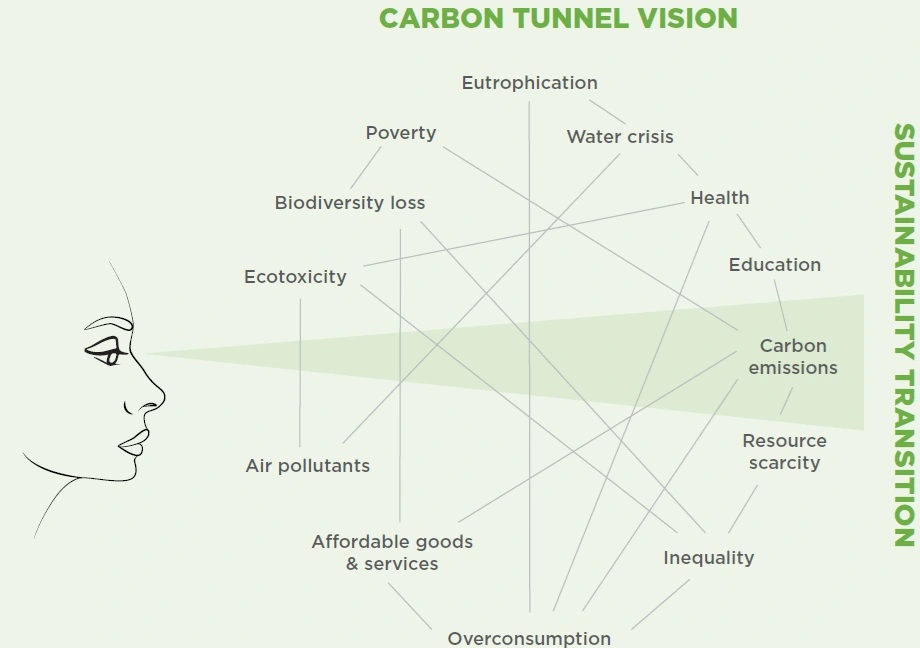
In November 2021, Jan Konietzko of Cognizant posted a graphic contrasting the narrow focus on emissions with the far wider field of environmental, social and governance concerns, labour standards, human rights, water, waste, resilience. It reached more than half a million people, because it named something everyone recognised. He called it carbon tunnel vision, and global mobility is deep inside it.
Meanwhile, the industry has no holistic picture of itself. What benchmarking exists tends to be a slice per region, or a global average with substantial gaps either side. That is arguably worse than none, because a partial benchmark still gets used as though it were complete.
The removal industry is not the first to work this out. Container shipping is the clearest parallel.
In 2019, nine of the world’s ten largest carriers – fierce competitors – founded the Digital Container Shipping Association (DCSA) to build common data standards. Its members now represent roughly 75% of global container trade, and the standards are open source, free to non-members and governed by a non-profit.
None lost an inch of ground; they simply stopped competing over the format of a bill of lading, of which DCSA estimated 16 million were issued in 2020, more than 99% on paper.
This summer has made the case better than any argument could. France is having its worst wildfire season on record: around 115,000 hectares burned by late July, and fires around Gironde forcing what has been called the country’s largest peacetime evacuation since the Second World War more than 220,000 people moved in that region alone, with Bordeaux ringed by smoke.
Spain evacuated on a similar scale. In Canada, a season that began quietly passed three million hectares by mid-July, with close to a thousand fires burning and smoke affecting roughly 100 million people across North America.
These are not remote places. They are origin and destination markets, partner territories, assignee locations. Each of those events reshaped routes, timings, capacity, insurance and duty-of-care obligations at short notice and an industry passing fragmented information by hand responds slowly when a region goes down.
Which is where benchmarking stops being an interesting extra and becomes strategic. Gathered consistently, information can be returned as benchmarks by country, by corridor, by type of operation. Layer location-level risk over it and a supplier can see which corridors carry real exposure to fire, flood, heat or social disruption; a client can see where the vulnerabilities sit rather than treating every location as equivalent. That is materiality in the practical sense: knowing which exposures matter most, and where to act first.
And as more movers work directly with relocating employees rather than only through intermediaries, a shared data layer makes it possible to give those individuals clear, accurate information about their own move which, in a disrupted season, is worth a great deal.
Impact Chain comes from within this industry, not from a technology company arriving to explain movers to themselves. Standards imposed from outside tend to fail; those grown from within tend to stick.
Nor are we alone in pulling this direction, FIDI, FEDEMAC and others have worked at the same problem from their own angles, and FIDI has said plainly that no coordinated approach yet exists in international relocation. That is the gap worth closing, together and it must work for the independent firm as well as the multinational, since smaller operators have most to gain from stripping out the burden that weighs heaviest without a back office to absorb it.
We are also set on investing in change as we aim to create a board from within the industry to identify next steps of the system roadmap, so our reinvestment goes into the changes the industry need, not what we guess it needs.
The immediate gains are real: less duplicated effort, cleaner compliance, faster handovers. The longer prize is an industry that spends less energy fighting its own plumbing and, for the first time, a clear view of where its risks sit. The companies that will define the next decade are those willing to collaborate where collaboration costs them nothing and gains them everything.
Impact Chain is being developed by and for the relocation industry. If these ideas resonate, whatever the size of your operation, click here to contact us.






All the best bits, delivered once a month straight to your inbox

News and insights from the movers and storers industry